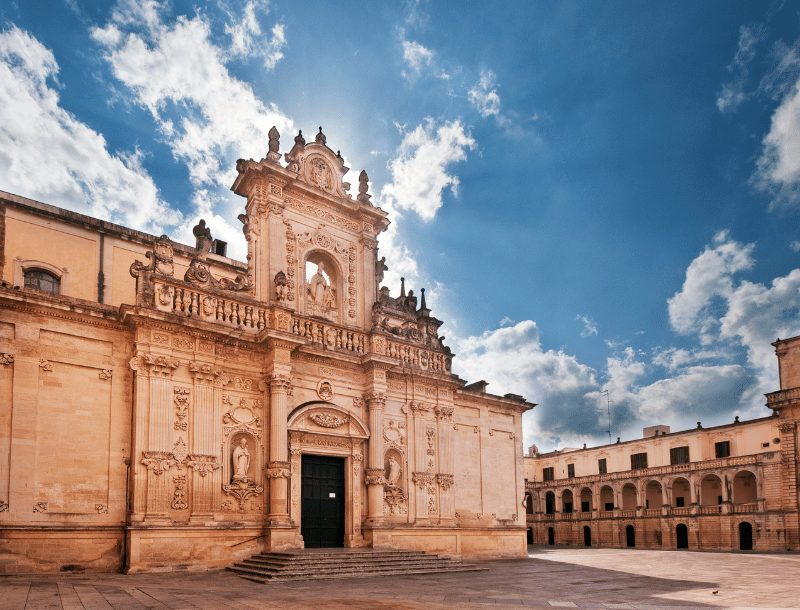
The Church of the Madonna del Curato in Ugento rises on a gentle hill, along the road that was named after the sanctuary itself. The small church dates back to the 14th century and was later rebuilt in two phases: the first between the late 1500s and early 1600s, after a fire; the second in the 19th century, when the vault was reconstructed in the traditional Salento style, known as a stella (star-shaped) vault.
The mystery of the name
Locals know it as the Church of the Madonna del Curato, a name that may have originated from the small barrel-vaulted room on the left side of the building, where the parish priest once lived.
However, the church’s original name was quite different: Madonna del Corallo, “Our Lady of the Coral.” The two words — corallo (coral) and curato (curate) — sound similar, and over time a sort of popular reinterpretation distorted the first into the second. And so, the Church of the Madonna del Corallo gradually became the Church of the Madonna del Curato.

Recent restoration works uncovered ancient frescoes and structural elements belonging to the church’s earliest phase. They also brought to light something else: several fragments of red coral. A coincidence? Perhaps not — they may have been devotional offerings (ex-votos) dedicated to the Madonna del Corallo. And with this discovery, the church’s true name re-emerges.
The “sinful” Madonna of the Milk
Inside the Church of the Madonna del Curato in Ugento, you can admire the fresco of the Madonna del Latte — the Madonna nursing the Child — one of the few surviving examples in Italy, dating to the first half of the 17th century. After that period, depictions of the Virgin breastfeeding were no longer permitted in religious buildings, as they were deemed “sinful” under the strict rules of the Catholic Counter-Reformation*.
On the right side of the church’s only altar, you’ll also find a full-figure fresco of Saint Vitus — once, the patron saint of Ugento, before being replaced by Saint Vincent (and, unofficially, in popular tradition, by the Saints Cosmas and Damian).
*The Catholic Counter-Reformation was the Church’s response to the Protestant Reformation, aimed at strengthening faith and discipline.

The Jewish Quarter and the Lost Greek Rite
The Church of the Madonna del Curato once stood in a particularly significant area of Ugento: very close to the defensive walls built in the 5th–6th centuries AD by the Eastern Roman Empire, and near what appears to have been a small Jewish quarter inhabited by several Jewish families living in the town.
Another intriguing detail: it seems that the church once hosted celebrations of the ancient Greek-rite liturgy of Catholic origin, which disappeared from the region in the early 19th century. This theory may be supported by traces of Byzantine-style paintings* still visible today.
* Byzantine art, primarily found in icons and mosaics, features stylized, gold-laden depictions of sacred figures, emphasizing spiritual reverence over earthly realism.